Cleansing of the Sanctuary Explained
Introduction and Review
The cleansing of the sanctuary explained. We introduced this topic in our last session Cleansing of the True Sanctuary (or see the video of that session here.)
We looked at:
- God’s dwelling place is a temple
- We are the temple of God
- Therefore, God wants to dwell in us
- Therefore, our temple must be cleansed
In this, part 2, we will look more closely at how our temple is cleansed.
First, just a little review. Our starting text in part 1 was:
“And he said unto me, Unto two thousand and three hundred days; then shall the sanctuary be cleansed.” (Daniel 8:14)
The question is what sanctuary is being referred to?
We established that:
God Lives in a Sanctuary, Tabernacle, Tent, House, Temple:
“… let them make me a sanctuary; that I may dwell among them. (Exodus 25:8-9)
From Hebrews 8, we saw that Jesus is:
“A minister of the sanctuary, and of the true tabernacle …” (Hebrews 8:2)
Jesus’ part in that ministry for His people is specific. He says:
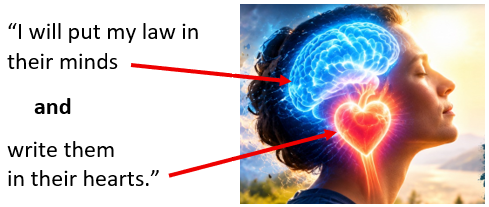
“… I will put my laws into their mind, and write them in their hearts …” (Hebrews 8:10)
There is somehow a significance in the separate mention of mind and heart.
Here is a verse for each of four sections we looked at:
- We are the Temple of God
“… ye are the temple of God … the Spirit of God dwelleth in you?” (1 Corinthians 3:16)
- God Wants to Dwell with/among His People
“And let them make me a sanctuary; that I may dwell among them.” (Exodus 25:8)
- God Wants to Dwell in His People
“… ye know him; for he dwelleth with you, and shall be in you.” (John 14:16–17)
- God Likes to Have a Clean House
“… Cleanse your hands, ye sinners; and purify your hearts …” (James 4:8)
There are numerous verses for each of those.
There is considerable evidence that we are meant to be
a dwelling for God and that we need to first be cleansed.
We looked, in the first part, at when the cleansing is to happen. There were three lines of evidence:
- Prophecies in Daniel
- Jesus’ Temple Cleansing
- William Miller
We will just briefly review that and then get into the most important part – what is the nature of that cleansing? How does it happen?
When is the Cleansing of the Sanctuary?
We gave evidence that the cleansing was to start in 1844, after a significant period of 46 years.
Herod’s temple took 46 years to build and then Jesus cleansed it.
From 1798 to 1844 = 46 years. Then the “sanctuary” began to be cleansed.
Daniel’s 2300 years = 46 x 50 Jubilee cycles starting from 457 BC (Daniel 9:25)
I wanted to add more evidence for the year 1798 marking the start of the time of the end.
“And at the time of the end shall the king of the south push at him: and the king of the north shall come against him like a whirlwind, with chariots, and with horsemen, and with many ships; and he shall enter into the countries, and shall overflow and pass over.” (Daniel 11:40)
There was a war in the year 1798 between the French under Napoleon and the Ottoman empire that matches the description.
“And at the time of the end shall the king of the south [Egypt] push at Him [France]: and the king of the north [The Turks] shall come against him [France] like a whirlwind, with chariots, and with horsemen, and with many ships [the Turkish fleet with allied Russian and English fleets]; and he shall enter into the countries [land], and shall overflow and pass over.” (Daniel 11:40, with notes)
That war and the background for understanding the identity of the kings of the north and south is described in Uriah Smith’s book Daniel and the Revelation p275.
There are 5 verses that use the phrase “the time of the end.” All are in Daniel and can be shown to have a connection to 1798 the start of the 46-year period leading to the beginning of the cleansing of the sanctuary.
There is a sense in which the true sanctuary began to be cleansed in 1844 after 46 years of “building” or preparatory work for that process. A large part of that building process came as a result of the studies of William Miller and his 14 rules for Bible study. https://characterofgod.org/william-millers-rules/
This verse fits in as well:
“But thou, O Daniel, shut up the words, and seal the book, even to the time of the end: many shall run to and fro, and knowledge of scripture shall be increased.” (Daniel 12:4)
At the time of the end, using the sound principles of Biblical interpretation devised by William Miller, scripture began to be understood in a different light – knowledge of scripture was increased. There is a sense in which that better understanding amounted to a cleansing of the sanctuary. However, the sanctuary being cleansed was not the earth itself as William Miller first believed, nor was it a cleansing of records of sin in a sanctuary in heaven.
The sanctuary to be cleansed was that which God has always been most concerned about cleansing – the sanctuary He wants to inhabit – us.
The Bible points to 1844 as the beginning of a cleansing
to prepare people to be a habitation/sanctuary for God.
What is to be Cleansed?
We need to be sure of what it is that is actually cleansed. What is the sanctuary? What is the dirt? What is it that defiles?
Is the Heavenly Sanctuary Being Cleansed?
The phrases “heavenly sanctuary” or “sanctuary in heaven” do not even appear in the King James Version of the Bible. “Sanctuary” appears in 128 Old Testament verses and in four New Testament verses of which three are referring to the Old Testament sanctuary which Moses built. The one use of “sanctuary” in the New Testament that does not refer to the Old Testament sanctuary is:
“A minister of the sanctuary, and of the true tabernacle, which the Lord pitched, and not man.” (Hebrews 8:2)
That verse is not referring to the Old Testament sanctuary as Jesus never officiated there in the role of a priest. That points to the importance of understanding Hebrew 8 as we did last time.
Here is one verse that does seem to indicate a sanctuary in heaven:
“For he hath looked down from the height of his sanctuary; from heaven did the LORD behold the earth;” (Psalm 102:19)
We make an assumption to equate that sanctuary in furnishings etc to the earthly tabernacle. However, “sanctuary,” in that verse, is actually from the Hebrew word “qodesh” which, in the majority of uses, is translated as “holy.” The original does not say “sanctuary.” Here is one version using a more-correct translation:
“that he looked down from his holy height; from heaven the LORD looked at the earth.” (Psalm 102:19, ESV)
A question one could ask is “was there an altar of burnt offering in heaven?” We could say that the altar of burnt offering in the heavenly system was where Christ died but that was the cross of Calvary which was on Earth. Also, would there have been any need of a sanctuary in heaven equivalent to the earthly sanctuary if there had been no sin? – no
As noted above, Jesus is physically located in heaven while He is ministering on behalf of the true tabernacle but it does not identify the nature of that tabernacle or temple or say where it is located.
Here is an interesting verse about the possibility of dirt in heaven:
“And there shall in no wise enter into it any thing that defileth, neither whatsoever worketh abomination, or maketh a lie: but they which are written in the Lamb’s book of life.” (Revelation 21:27)
The verse is talking about the holy city, the New Jerusalem. Nothing that defiles will be in it. Is it reasonable that nothing defiling would be in heaven? We could question even records of sin, however, records of evil are not evil.
Are there Records of Sin in Heaven?
But where are verses saying that records of sin are to be cleansed in heaven?
I asked this online:
What are the verses most used to promote the idea that it is the record of sins that are removed from the heavenly sanctuary?
We’ll look at the verses I was given.
“Repent ye therefore, and be converted, that your sins may be blotted out, when the times of refreshing shall come from the presence of the Lord;” (Acts 3:19)
What does it say is blotted out?
“I beheld till the thrones were cast down, and the Ancient of days did sit, whose garment was white as snow, and the hair of his head like the pure wool: his throne was like the fiery flame, and his wheels as burning fire. A fiery stream issued and came forth from before him: thousand thousands ministered unto him, and ten thousand times ten thousand stood before him: the judgment was set, and the books were opened.” (Daniel 7:9-10)
It doesn’t say who is judging or judged. It doesn’t say which books are opened. It doesn’t say anything about erasing records.
“And I saw the dead, small and great, stand before God; and the books were opened: and another book was opened, which is the book of life: and the dead were judged out of those things which were written in the books, according to their works.” (Revelation 20:12)
That is “stand” in a figurative sense. There is no mention of erasing anything. A “judgment” does need to be made of every person but that is merely a recognition of what they have made of themselves – sheep or goat?
“I, even I, am he that blotteth out thy transgressions for mine own sake, and will not remember thy sins.” (Isaiah 43:25)
Does God forget our sins? Will He ban the Bible from heaven? He does not remember sins in terms of remembering to punish us for them.
“(Love) … thinketh no evil.” (1 Cor 13:5)
“(Love) … keeps no record of wrongs.” (1 Cor 13:5, NIV)
There is no mention of erasing records. Blotting out could be parallel to not remembering.
“Have mercy upon me, O God, according to thy lovingkindness: according unto the multitude of thy tender mercies blot out my transgressions. … Hide thy face from my sins, and blot out all mine iniquities.” (Psalm 51:1, 9)
Blot out transgressions and iniquities, not the mere record of them.
David said “… my sin is ever before me.” (Psa 51:2) – did he expect to suddenly not remember; to have no remembrance of his sin? Did David know that God was not going to blot out his sins for another about 19 centuries? (Psa 51:9)
“And he said unto me, Unto two thousand and three hundred days; then shall the sanctuary be cleansed.” (Daniel 8:14)
The common understanding that the sanctuary contains records of sins is only an assumption. We have to admit that there is not much Biblical evidence that the record of sins is to be erased.
The Medical Record AnalogyA doctor’s records show the condition of the patient. The only legitimate way to “cleanse” those records, is to record an actual change in the patient’s condition. Erasing the records of symptoms of a sick person does nothing to cleanse the person. |
 |
Ultimately, what is to be cleansed? – is it your record or you?
“Many shall be purified, and made white, and tried; but the wicked shall do wickedly: and none of the wicked shall understand; but the wise shall understand.” (Daniel 12:10)
What is being purified is many people (“the wise”) NOT many records.
More claimed support for records being removed comes from verses such as Dan 7:9-10, Dan 8:14, Psa 51:1,9, Isa 43:25 Acts 3:19 and Rev 20:12 but none of those actually say the record of sins will be removed.
More information about the records at: https://characterofgod.org/records-of-heaven/
It is looking quite doubtful that there are records of sin in heaven that are the subject of cleansing.
There is not a single verse that says a record of sins is to be cleansed from a sanctuary in heaven.
- Few verses that even suggest it
- God is ever-merciful – He forgives
- We are the temple
- Doctor’s records
- Attitude more than behavior
- Cleansing records does nothing for the person
There is little evidence that God keeps a legal account of sins. The
Bible says: Love “… keeps no record of wrongs.” (1 Cor 13:5, NIV)
If it is not a record of sins that is to be cleansed, what is to be cleansed? It must be us; the sinners.
“Draw nigh to God, and he will draw nigh to you. Cleanse your hands, ye sinners; and purify your hearts, ye double minded.” (James 4:8)
Cleanse your hands, ye sinners – our actions
purify your hearts, ye double minded – our thinking
We are Each a Temple
There are many verses that say or suggest that the temple/sanctuary referred to is ourselves. God wants to dwell in us through His Spirit:
Last time we saw that:
ye are the temple (1 Cor 3:16)
your body is the temple (1 Cor 6:19)
ye also are builded together for an habitation of God (Eph 2:22)
Ye also, as lively stones, are built up a spiritual house (1 Pet 2:5)
There are more God-dwelling-in-us verses:
“He that eateth my flesh, and drinketh my blood, dwelleth in me, and I in him.” (John 6:56)
“Even the Spirit of truth; whom the world cannot receive, because it seeth him not, neither knoweth him: but ye know him; for he dwelleth with you, and shall be in you.” (John 14:17)
“But ye are not in the flesh, but in the Spirit, if so be that the Spirit of God dwell in you. Now if any man have not the Spirit of Christ, he is none of his. And if Christ be in you, the body is dead because of sin; but the Spirit is life because of righteousness. But if the Spirit of him that raised up Jesus from the dead dwell in you, he that raised up Christ from the dead shall also quicken your mortal bodies by his Spirit that dwelleth in you.” (Romans 8:9-11)
“For we are labourers together with God: ye are God’s husbandry, ye are God’s building.” (1 Corinthians 3:9)
“I am crucified with Christ: nevertheless I live; yet not I, but Christ liveth in me: and the life which I now live in the flesh I live by the faith of the Son of God, who loved me, and gave himself for me.” (Galatians 2:20)
“That good thing which was committed unto thee keep by the Holy Ghost which dwelleth in us.” (2 Timothy 1:14)
“But Christ as a son over his own house; whose house are we, if we hold fast the confidence and the rejoicing of the hope firm unto the end.” (Hebrews 3:6)
“Yea, I think it meet, as long as I am in this tabernacle, to stir you up by putting you in remembrance; knowing that shortly I must put off this my tabernacle, even as our Lord Jesus Christ hath shewed me.” (2 Peter 1:13-14)
“Whosoever shall confess that Jesus is the Son of God, God dwelleth in him, and he in God. And we have known and believed the love that God hath to us. God is love; and he that dwelleth in love dwelleth in God, and God in him.” (1 John 4:15-16)
“No man hath seen God at any time. If we love one another, God dwelleth in us, and his love is perfected in us.” (1 John 4:12)
“For the time is come that judgment must begin at the house of God: and if it first begin at us, what shall the end be of them that obey not the gospel of God?” (1 Peter 4:17)
We are the house of God.
“God forbid: yea, let God be true, but every man a liar; as it is written, That thou mightest be justified in thy sayings, and mightest overcome when thou art judged.” (Romans 3:4)
Could this mean the judgment of God/His actions would begin
with His people and they would start judging before others?
“In the cleansing of the temple, Jesus was announcing His mission as the Messiah, and entering upon His work. That temple, erected for the abode of the divine Presence, was designed to be an object lesson for Israel and for the world. From eternal ages it was God’s purpose that every created being, from the bright and holy seraph to man, should be a temple for the indwelling of the Creator. Because of sin, humanity ceased to be a temple for God. … In cleansing the temple from the world’s buyers and sellers, Jesus announced His mission to cleanse the heart from the defilement of sin …” (The Desire of Ages, 161)
“An object lesson” is a lesson designed to teach truth.
The Lamb’s Book of Life
When the cleansing of the sanctuary is talked about, it is often connected with records in heaven including the Book of Life.
“He that overcometh, the same shall be clothed in white raiment; and I will not blot out his name out of the book of life, but I will confess his name before my Father, and before his angels.” (Revelation 3:5)
The Book of Life contains not a record of sins but the names, the characters, the record of each saved person. Here is an interesting verse from the description of the Second Coming:
“For if we believe that Jesus died and rose again, even so them also which sleep in Jesus will God bring with him.” (1 Thessalonians 4:14)
The context is the Second Coming:
“… the coming of the Lord …” (v15)
“… the Lord himself shall descend from heaven …” (v16)
Are “them … which sleep in Jesus” also written in the book of life?
“bring with him” from where? It must be from heaven.
What is He bringing? Not the bodies of the dead – those are in the graves. It is the record, the names, the characters of each person.
| Computer | Greek | Examples | People at death | |
| hardware | body | soma | somatic | returns to dust |
| battery | spirit | pneuma | pneumatic | breath, energy is disconnected |
| software, data | soul | psyche | psychology | individual, mind, personality, spirit, ruach, returns to God Eccl 12:7 |
Board + nails = box
Bulb + electricity = light
Dust + breath of life = a living soul (nephesh, H5315; Gen 2:7)
There is often confusion because the word “spirit” is used differently in the old and new testaments:
The KJV, in the OT, uses “spirit” = soul, psyche, ruach – the individual
The KJV, in the NT, uses “spirit” = breath, pneuma – the energy
See a video of a study on death and resurrection.
We can back up our digital data on the cloud; so can God. The individual “sleeps” (as Jesus referred to the state of death) until their data is downloaded onto new (incorruptible) hardware.
God has to put us back together – right? We will get both hardware and software upgrades but we will still be ourselves. God somehow retains a record of us in order to restore us. That record is in the Lamb’s book of life containing the life-record of each person.
When it comes to cleansing, it is character that is the concern, not records of sins:
“Behold, I will send my messenger, and he shall prepare the way before me: and the Lord, whom ye seek, shall suddenly come to his temple, even the messenger of the covenant, whom ye delight in: behold, he shall come, saith the LORD of hosts. But who may abide the day of his coming? and who shall stand when he appeareth? for he is like a refiner’s fire, and like fullers’ soap: And he shall sit as a refiner and purifier of silver: and he shall purify the sons of Levi, and purge them as gold and silver, that they may offer unto the LORD an offering in righteousness.” (Malachi 3:1-3)
How is the Sanctuary Cleansed?
There are a few points to consider before we get into the details (next time).
You Can’t Clean Yourself Up
That the cleansing is not our own work is supported by a number of verses:
“Who can say, I have made my heart clean, I am pure from my sin?” (Proverbs 20:9)
Who can say “I am pure” (condition) as a result of what they have done (“I have made”)? This is a rhetorical question the answer to which is no one can.
“Not by works of righteousness which we have done, but according to his mercy he saved us, by the washing of regeneration, and renewing of the Holy Ghost;” (Titus 3:5)
“How much more shall the blood of Christ, who through the eternal Spirit offered himself without spot to God, purge your conscience from dead works to serve the living God?” (Hebrews 9:14)
Invite Jesus In
Jesus has to be invited in; He will not force His way:
“If ye then, being evil, know how to give good gifts unto your children: how much more shall your heavenly Father give the Holy Spirit to them that ask him?” (Luke 11:13)
Satan will impose himself as much as he can.
“When the unclean spirit is gone out of a man, he walketh through dry places, seeking rest, and findeth none. Then he saith, I will return into my house from whence I came out; and when he is come, he findeth it empty, swept, and garnished. Then goeth he, and taketh with himself seven other spirits more wicked than himself, and they enter in and dwell there: and the last state of that man is worse than the first. Even so shall it be also unto this wicked generation.” (Matthew 12:43-45)
Does that suggest that, if Jesus is not there, the unclean spirits can just move in?
“And I will put my spirit within you, and cause you to walk in my statutes, and ye shall keep my judgments, and do them.” (Ezekiel 36:27)
David – Create in Me a Clean Heart
The experience of King David is interesting regarding cleansing. Let’s look at Psalm 51.
“Have mercy upon me, O God, according to thy lovingkindness: according unto the multitude of thy tender mercies blot out my transgressions. Wash me throughly from mine iniquity, and cleanse me from my sin.” (Psalm 51:1-2)
Note that it is not:
“blot out the record of my transgressions.”
“… cleanse me from the record of my sin.”
A few verses in that Psalm suggest two parts:
“Behold, thou desirest truth in the inward parts: and in the hidden part thou shalt make me to know wisdom.” (Psalm 51:6)
“inward parts”
H2910 טֻחָה tuwchah too-khaw’ or (plural) טחות
from H2909 (or H2902) in the sense of overlaying; n f p;
AV-inward parts 2; 2
1) inner regions, hidden recesses, inward parts
“Create in me a clean heart (leb, H3820), O God; and renew a right spirit (ruach H7307): within me.” Psalm 51:10)
“The sacrifices of God are a broken spirit (ruach H7307): a broken and a contrite heart (leb, H3820), O God, thou wilt not despise.” Psalm 51:17)
I am suggesting a division into two parts that could be identified as:
| Conscious | Subconscious | |
| hidden part | inward parts (tuwchah, H2910) | verse 6 |
| clean heart (leb, H3820) | right spirit (ruach H7307) | verse 10 |
| contrite heart (leb, H3820) | broken spirit (ruach H7307) | verse 17 |
| the heart (H7907) | inward parts (H2910) | (Job 38:36) |
We will talk about that next time and here is a little preview.
The two parts we see in Psalm 51 are like we see in this verse:
“For this is the covenant that I will make with the house of Israel after those days, saith the Lord;
I will put my laws into their mind,
and write them in their hearts:
and I will be to them a God, and they shall be to me a people:”
(Hebrews 8:10)
Remember: “I will put my laws into their mind, and write them in their hearts”
Mind and heart. Two parts. The sanctuary was composed of two parts which is going to be quite important to understand in the process of the cleansing of our minds. Is this equivalence a possibility?
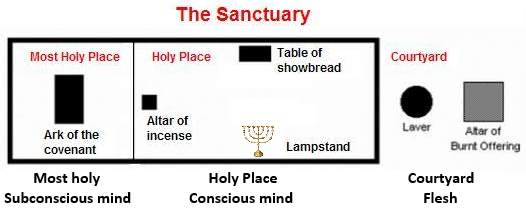
Our minds clearly have two parts as illustrated here:
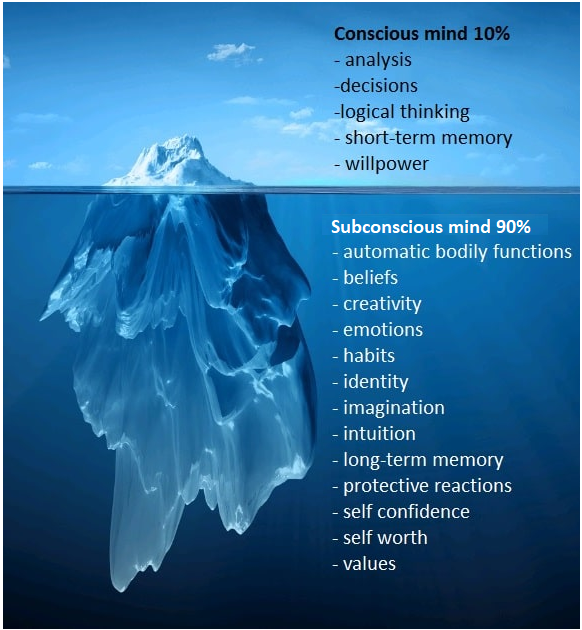
Cognitive Dissonance
Cognitive dissonance is the mental discomfort or tension you feel when you hold two contradictory beliefs, values, or ideas at the same time, or when your behavior clashes with what you believe.
Many would say they believe that both:
- God is perfectly loving, merciful, compassionate, and forgiving.
- God will ultimately kill those who do not accept Him and follow Him.
There are various ways that the mind resolves what appears to be a contradiction.
In part 3 we will see how to cleanse our minds and resolve this cognitive dissonance so that we can get to this point:
“Great peace have they which love thy law: and nothing shall offend them.” (Psalm 119:165)
“Great peace [of mind] have they which [understand and] love thy law: and nothing shall offend them [or cause them to stumble or fall].” (Psalm 119:165, expanded)
“offend”
H4383 מִכְשׁוֹל mikshowl mik-shole’ or מכשׁל mikshol mik-shole’
from H3782; n m;
AV-stumblingblock 8, offence 2, ruins 2, offend 1, fall 1; 14
1) a stumbling, means or occasion of stumbling, stumbling block
1a) stumbling, fall
1b) means or occasion of stumbling, stumbling block
Could correctly understanding God’s law be a protection from spiritually falling?
