God Does Not Kill
God does not kill – or does He? I gave a friend a ride into town recently. We talk about spiritual issues and he has read some of my booklets. I asked if he believes that God kills and he said “no.” He is not very familiar with the Bible but, if he read it, he might change his opinion. Why would I say that?
Because the Bible says that God kills. Especially if my friend started reading in the Old Testament, perhaps the book of Judges, he might reconsider. There are, I admit, verses in our English Bibles that literally promote that:
“See now that I, even I, am he, and there is no god with me: I kill, and I make alive; I wound, and I heal: neither is there any that can deliver out of my hand.” (Deuteronomy 32:39)
People will bring that verse up pretty quickly to defend a killer God.
Does God Kill? The Bible says Yes, but …
One could list many verses that read as though God, by His own direct action, kills people. Such verses are found in these stories and others:
- The flood
- Sodom and Gomorrah
- Passover in Egypt
- Korah’s rebellion
- Uzzah
- King Saul
Other verses seem to indicate God directed His angels or His people to kill:
- Nadab and Abihu
- The Assyrian army
- King Herod (in Acts 12)
- Wars in conquering Canaan
Still others record deaths commonly attributed to (without explicitly saying it was by) God’s action or direction:
- Ananias and Sapphira
So, a person might mockingly ask “What part of ‘I kill’ do you not understand?” But not so fast. There are things the mocker does not understand as well.
Does God Kill? How to Resolve
| Many people will say “the Bible says it and I believe it.” Seems simple enough but we have previously studied and determined that there are many factors that impact correct Bible understanding.
See a video of that study here: |
 |
People misread the Bible because they fail to take into account:
- Changes in word meanings over time
- Traditional understanding
- Translator bias
- Idioms
- Metaphors
- Parables
- Personification
- Verb forms (hiphil)
- Verb tenses
- Flashbacks
- The permissive sense
- Rhetorical statements
- Common sense
- Exaggeration
- Hyperbole
- Accommodation
- Parenthetical
- Punctuation
- Verse divisions
- Non-chronological themes
- A veil over understanding
- Symbolism Revelation
- Narrative framing
- Imposing a strictly linear timeline
And then there are factors that contradict God kills:
- God is love
- Ten commandments
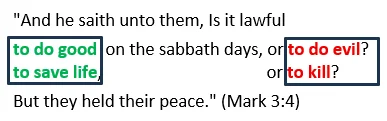
- To kill = to do evil:
What we want to do is:
- Look at the ramifications of believing either God does kill or does not kill.
- Consider if the question “does God kill” is even important. Why bother to investigate? Does it matter what we believe?
- Look for indications of problems with either position.
- Find any contradictions within the Word, suggesting the need to dig deeper and, through comparing original word meanings and other means, resolve as many contradictions as possible.
A simple example of a contradiction is the Bible saying both that God killed King Saul and that Saul killed himself – an obvious contradiction.
Saul killed himself
“Then said Saul to his armourbearer, Draw thy sword, and thrust me through therewith; lest these uncircumcised come and abuse me. But his armourbearer would not; for he was sore afraid. So Saul took a sword, and fell upon it. And when his armourbearer saw that Saul was dead, he fell likewise on the sword, and died.” (1 Chronicles 10:4-5)
God killed Saul
“So Saul died for his transgression which he committed against the LORD, even against the word of the LORD, which he kept not, and also for asking counsel of one that had a familiar spirit, to enquire of it; And enquired not of the LORD: therefore he slew him, and turned the kingdom unto David the son of Jesse.” (1 Chronicles 10:13-14)
That is an obvious contradiction even within the same chapter.
Consequences of Teaching God Does or Does Not Kill
I was challenged (from the assumption that God does kill) to consider the consequences or ramifications of teaching to children or others that God does not kill. (In other words, I was told it is a bad idea and could be harmful to teach that.) Let’s consider both sides.
If God DOES KILL and we teach that He does not, such teaching could or would:
- be a wrong teaching.
- lead to confusion as people understand, from their reading scripture, that He does.
- cause loss of confidence in the plain reading of scripture.
- lead to careless disregard for law keeping – if no direct punishment.
- lead to seeing God as not concerned about justice.
- lead to universalism.
- lead to confusion about God’s justice.
I would counter that there are dangers in the opposite position as well.
If God DOES NOT KILL and we teach that He does, such teaching could or would:
- be a wrong teaching.
- lead to viewing God as looking out more for self than for others.
- put fear of God (of the wrong sort) into people.
- destroy true love for God as love cannot be forced.
- lead to people wanting nothing to do with God.
- lead to people seeing God as hypocritical – doing what He tells us not to do.
| This would be like many parents do with their young children even if they do believe in a killer God. They start off teaching children
that gentle Jesus meek and mild is their friend and later they learn the theology that actually they could be killed by Him in the end if they don’t live up to His requirements. This is like teaching about a good, gift-giving Santa Claus only for them the find out later that it is all a lie. So, if we are teaching “God is love” to young children and they later learn that if they don’t meet God’s requirements, He will kill them – what will that do for them? |
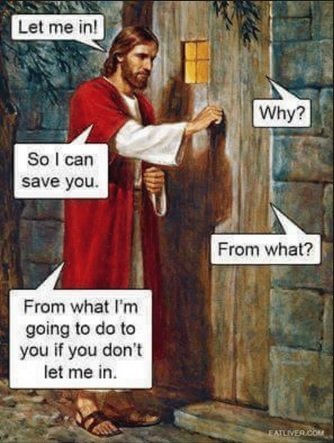 |
The illustration of Jesus knocking at the door describes the reality in the God-kills understanding. I would like to hear how those who believe it get around this.
I would prefer, when I get to heaven, for God to say to me:
“you know you made me out to be better than I really am.”
rather than
“you accused me of a lot of murders when I never committed any.”
If I am going to err in this matter, I prefer to err on the side of God is and does good always as seen in Jesus.
Arguments that God Does Not Kill
Since, on the surface, the Bible seems to suggest that God does kill, we need to look at any factors evidencing that He does not.
Miller’s Rules
In doing that, we should remember Miller’s rules https://characterofgod.org/william-millers-rules/ of which number 4 is:
“IV. To understand doctrine, bring all the Scriptures together on the subject you wish to know; then let every word have its proper influence; and if you can form your theory without a contradiction, you cannot be in error. Proof; Isa. 28:7-29; 35:8. Prov. 19:27. Luke 24:27, 44, 45. Rom. 16:26. Jms. 5:19. 2 Pet. 1:19, 20. [see also John 7:16, 17].”
Principles
And it is important to consider the big picture and principles.
 |
 |
There is a saying “Can’t see the forest for the trees.”
“‘Missing the forest for the trees’ means being too focused on small details or individual components (a single tree) to understand or appreciate the larger situation, goal, or overall picture (the whole forest). It implies losing perspective because of excessive preoccupation with minor elements.” (Miriam Webster)

This illustrates the concept of the need to prioritize big picture principles such as God is love, treat enemies with love etc. Incidents in the Bible that seem inconsistent with that cannot be taken at face value (literally), but must be suspect and need be resolved.
If we focus on certain individual stories and determine that their literal reading must represent God we risk going wrong in our understanding of Him. Remember:
To Get the Message You Need to
Know the Meaning of the Words
God is Love
The character trait most associated with God is love:
“He that loveth not knoweth not God; for God is love.” (1 John 4:8)
And that (agape) love is described here:
“Love suffers long and is kind; love does not envy; love does not parade itself, is not puffed up; does not behave rudely, does not seek its own, is not provoked, thinks no evil; does not rejoice in iniquity, but rejoices in the truth; bears all things, believes all things, hopes all things, endures all things.” (1 Cor 13:4-7)
Some would argue that, at times, it is the loving thing to do for God to kill a person to put them out of misery or to protect His people. We might put an animal down – euthanize a very sick or injured animal that has no hope of recovery.
However, to kill is to take away free will and further opportunity to make a choice for or against eternity. That does not apply to animals.
Not Willing
“The Lord is not slack concerning his promise, as some men count slackness; but is longsuffering to us-ward, not willing that any should perish, but that all should come to repentance.” (2 Peter 3:9)
“For I have no pleasure in the death of him that dieth, saith the Lord GOD: wherefore turn yourselves, and live ye.” (Ezekiel 18:32)
If God takes no pleasure in death and is not willing that any should perish, why would He go against His own will and personally kill anyone?
Logic
Consider this: Imagine that one of God’s people in a saved condition was being attacked by someone seeking to kill him. It would not make sense for God to kill the unsaved attacker. That would end, not only his life, but his opportunity to repent, turn to God and be saved. God Who is not willing that any should perish would, logically, allow the saved person to die and then try to turn the murderer around to also be saved.
“Cast away from you all your transgressions, whereby ye have transgressed; and make you a new heart and a new spirit: for why will ye die, O house of Israel?” (Ezekiel 18:31)
“In burnt offerings and sacrifices for sin thou hast had no pleasure.” (Hebrews 10:6)
“Whosoever therefore shall break one of these least commandments, and shall teach men so, he shall be called the least in the kingdom of heaven: but whosoever shall do and teach them, the same shall be called great in the kingdom of heaven.” (Matthew 5:19)
If God is teaching men to break His commandments, would God be the least in the kingdom of heaven? Admittedly that is stretching the argument because to kill is not one of the least commandments but …
Is suicide a sin?
In God’s eyes is intent to sin considered as doing it?
If one attempts suicide and fails, would God kill them for it?
“And God said unto Noah, The end of all flesh is come before me; for [or because] the earth is filled with violence through them; and, behold, I will destroy them with the earth.” (Genesis 6:13)
Can you imagine God, grieved at the condition of mankind (Gen 6:6) and saying:
“I can see that they are destroying themselves so I will destroy them.”
Death Comes from Sin Itself
The Bible teaches that death comes from sin itself rather than from God:
“For the wages of sin is death; but the gift of God is eternal life through Jesus Christ our Lord.” (Romans 6:23)
“For sin pays its wage–death; but God’s free gift is eternal life in union with Christ Jesus our Lord.” (Romans 6:23, Good News Translation)
“Then when lust hath conceived, it bringeth forth sin: and sin, when it is finished, bringeth forth death.” (James 1:15)
“Evil [not God] shall slay the wicked: and they that hate the righteous shall be desolate.” (Psalms 34:21)
Satan is the Destroyer
Satan is the destroyer, not God. In this passage, the LORD is not preventing Himself from entering the houses:
“For the LORD will pass through to smite the Egyptians; and when he seeth the blood upon the lintel, and on the two side posts, the LORD will pass over the door, and will not suffer the destroyer to come in unto your houses to smite you.” (Exo 12:23)
Satan is further referred to as the destroyer:
“Neither murmur ye, as some of them also murmured, and were destroyed of the destroyer.” (1 Cor 10:10)
“Concerning the works of men, by the word of thy lips I have kept me from the paths of the destroyer. Hold up my goings in thy paths, that my footsteps slip not. (Psa 17:4-5)
https://characterofgod.org/the-destroyer-definition/
The Hiphil Verb Form
This is very important to understand and is covered thoroughly in the two pages linked below. PLEASE DO NOT SKIP OVER THIS FACTOR.
https://characterofgod.org/hiphil-verb-form/ – God is frequently said, in scripture. to do what He merely allows as in this quote:
“… the Form called hiphil in Hebrew often denotes only permission, and is rendered elsewhere to that sense by our translators.” (Lowth, William, A Commentary upon the Prophet Isaiah, London, W. Taylor, 1714, p501)
This page https://characterofgod.org/i-create-evil/ documents how this idiom of permission was well-understood in the past and shows many examples from the 1800’s.
When this is taken into account, we can see that many verses which read in English as though God killed or did other negative things are actually saying that God merely allowed or did not prevent an event from happening (from a source other than Himself).
The Ten Commandments
“Thou shalt not kill.” (Exodus 20:13)
Does God tell us not to kill and He does it Himself? Isn’t that something close to hypocrisy?
Jesus Rebuked the Spirit of Revenge
When Jesus entered a village of the Samaritans, they did not welcome Him and they left for another village. Two of His disciples had a strong reaction:
“And when his disciples James and John saw this, they said, Lord, wilt thou that we command fire to come down from heaven, and consume them, even as Elias did?” (Luke 9:54)
It is significant to note Jesus’ response to an attitude that many would believe (and two of His disciples did believe) to have been appropriate:
“But he turned, and rebuked them, and said, Ye know not what manner of spirit ye are of.” (Luke 9:55)
Note that what Jesus indicated was wrong was the spirit, the attitude, of the disciples. It wasn’t a case of something like “now is not the right time” or “I will get my vengeance later.”
Jesus Claimed to Represent His Father’s Character
“Jesus saith unto him, Have I been so long time with you, and yet hast thou not known me, Philip? he that hath seen me hath seen the Father; and how sayest thou then, Shew us the Father?” (John 14:9)
“But I say unto you, Love your enemies, bless them that curse you, do good to them that hate you, and pray for them which despitefully use you, and persecute you; That ye may be the children of your Father which is in heaven: for he maketh his sun to rise on the evil and on the good, and sendeth rain on the just and on the unjust.” (Matthew 5:44-45)
Jesus identified those who love their enemies as like God who loves and blesses His enemies.
“Who being the brightness of his glory, and the express image of his person, and upholding all things by the word of his power, when he had by himself purged our sins, sat down on the right hand of the Majesty on high;” (Hebrews 1:3)
“Express image” in that verse is from the Greek word “charakter” (G5481) from which we get our word “character.”
Arguments that God Does Kill
The Direct Statement “I Kill”
Here is the most direct statement that reads as though God Himself is saying in His own words that He does kill:
“See now that I, even I, am he, and there is no god with me: I kill, and I make alive; I wound, and I heal: neither is there any that can deliver out of my hand.” (Deuteronomy 32:39)
But can we be sure that it means to kill as in the end the physical life of a person? There are many verses that could link God “killing” to a spiritual death:
“For he maketh sore, and bindeth up: he woundeth, and his hands make whole.” (Job 5:18)
“I protest by your rejoicing which I have in Christ Jesus our Lord, I die daily.” (1 Corinthians 15:31)
“Wherefore if ye be dead with Christ from the rudiments of the world, why, as though living in the world, are ye subject to ordinances,” (Colossians 2:20)
“For ye are dead, and your life is hid with Christ in God.” (Colossians 3:3)
“For I through the law am dead to the law, that I might live unto God. I am crucified with Christ: nevertheless I live; yet not I, but Christ liveth in me: and the life which I now live in the flesh I live by the faith of the Son of God, who loved me, and gave himself for me.” (Galatians 2:19-20)
“And you hath he quickened, who were dead in trespasses and sins;” (Ephesians 2:1)
“Even when we were dead in sins, hath quickened us together with Christ, (by grace ye are saved;)” (Ephesians 2:5)
God has to Kill in Order to be Just
“The wages of (penalty for) sin is death” is commonly taken to mean God must kill. However, it has been shown above that death comes from (the natural consequences of) sin itself.
Some would say: “If God is fully just, He must punish our sins fully without holding back” or “every sin must be punished.”
But why then would He personally kill some when other lost sinners die natural deaths? Justice also has to do with treating all alike, applying the same rules to everyone. Otherwise, it is favoritism.
“Wherefore now let the fear of the LORD be upon you; take heed and do it: for there is no iniquity with the LORD our God, nor respect of persons, nor taking of gifts.” (2 Chronicles 19:7)
The idea that God must punish unrepentant sinners with death comes from a misunderstanding of God’s system of justice. See these pages:
https://characterofgod.org/gods-justice-in-the-bible/
https://characterofgod.org/god-is-just-definition/
From that page:
“God is just in that He always does the right thing … What is right from His character of love includes honoring the free will of others allowing complete freedom of choice without force or any threat. When we choose wrong, He freely allows us to experiences the consequences we have (knowingly or unknowingly) chosen. ‘You reap what you sow.’ That is the sense in which God ‘punishes’ sin …”
That is backed up by this important verse:
“Keeping mercy for thousands, forgiving iniquity and transgression and sin, and that will by no means clear the guilty; visiting the iniquity of the fathers upon the children, and upon the children’s children, unto the third and to the fourth generation.” (Exodus 34:7)
Also see: https://characterofgod.org/meaning-of-exodus-20-5/
God allows natural consequences and sins themselves have negative consequences which result in punishment – you reap what you sow.
- Wherefore God also gave them up …” (Romans 1:24)
- For this cause God gave them up …” (Romans 1:26)
- God gave them over to …” (Romans 1:28)
- “So I gave them up unto their own hearts’ lust …” (Psalm 81:12)
- “Ephraim is joined to idols: let him alone.” Hosea 4:17
Isn’t saying that God has to operate according to strict justice making God subject to justice? Doesn’t He get to specify how His own justice is to operate?
He describes justice in His word:
“Justice and judgment are the habitation of thy throne: mercy and truth shall go before thy face.” (Psalms 89:14)
Notice how “justice and judgment” are paired with “mercy and truth.”
“The LORD is known by the judgment which he executeth: the wicked is snared in the work of his own hands. Higgaion. Selah.” (Psalms 9:16)
When God carries out justice; when He executes His judgments it is simply to allow the natural consequences of sin. He allows (does not protect) the wicked from beings snared by their own works.
The results of God’s justice is to allow the natural consequences of sin. It does not say “The LORD is known by the judgment which he executeth: God makes sure to punish every sin.”
This verse describes justice:
“Defend the poor and fatherless: do justice to the afflicted and needy. Deliver the poor and needy: rid them out of the hand of the wicked.” (Psalms 82:3-4)
Justice is basically just doing the right thing.
God Says He takes Vengeance
“Dearly beloved, avenge not yourselves, but rather give place unto wrath: for it is written, Vengeance is mine; I will repay, saith the Lord.” (Romans 12:19)
But that contradicts:
“But I say unto you, That ye resist not evil: but whosoever shall smite thee on thy right cheek, turn to him the other also.” (Matthew 5:39)
Here is an explanation of how God’s vengeance works: https://characterofgod.org/biblical-vengeance/ There is a very good 2-minute audio there by Graham Maxwell.
God does not take vengeance by killing His enemies.
Thou Shalt Not Kill Means Thou Shalt not Murder
I have heard the argument that the commandment prohibits murder only and not killing as in judicial execution or in service of one’s country in war. The difference between killing and murdering, of course, is that murder involves intent to kill or pre-meditation.
This page https://characterofgod.org/bible-definition-of-kill/ shows that the word for “to kill” is “ratsach” which is used for both intentional and accidental killing.
Would God ever kill anyone accidentally, without intent or pre-meditation? Could we ever expect God to say:
“Oops, I didn’t mean to kill that one.”
God’s nature is to give and sustain life, not to destroy it. It would be against His nature to kill in any way.
“The thief cometh not, but for to steal, and to kill, and to destroy: I am come that they might have life, and that they might have it more abundantly.” (John 10:10)
“Jesus saith unto him, I am the way, the truth, and the life: no man cometh unto the Father, but by me.” (John 14:6)
“For I know the thoughts that I think toward you, saith the LORD, thoughts of peace, and not of evil, to give you an expected end.” (Jeremiah 29:11)
That describes God’s thoughts towards those who were not yet seeking Him.
Also consider this verse:
“The last enemy that shall be destroyed is death.” (1 Corinthians 15:26)
It makes no sense that God would be using what is to Him an enemy to carry out His purposes.
God is a Consuming Fire
God burns up His enemies some would say. After all, His mere presence is a consuming fire:
“For our God is a consuming fire.” (Hebrews 12:29)
But that text does not say that for example, if you get too close to God you will ignite and burn. Nor does it say He lights on fire those He wants to or has to destroy. And, importantly, the meaning of “consuming” must be determined by the Bible’s use of the original words.
See this video https://youtu.be/KsAfM8JHJ7Q for a study of the meaning of Hebrews 12:29
Actually, it is when God finally leaves the sinner that the sinner is “consumed;” – in the Biblical sense of the original word’s meaning.
But There are so Many Accounts of God Killing
There are many verses that read as though God is killing by His own hand or directing His agents to kill. Those are in direct contradiction to the factors identified above indicating that God does not kill. Such contradictions must be resolved. We cannot simply do away with “God is Love,” “love your enemies” etc. From the factors we have identified, many such passages can be easily resolved.
Admittedly, there are some more difficult ones to explain in favor of the position that God does not kill. As time allows, those individual passages will be examined and the results added to this website. Such study must take into account the many factors described earlier. To ignore them is to risk coming to a wrong conclusion.
Each person, of course, is free to choose what they will believe.
Other Considerations
Pressuring People to Believe
Is it a good idea to pressure people to believe that God does not kill?
People like to believe what they have always believed. They don’t like to admit they may be wrong. Many want to have a God like themselves.
After giving a presentation where I spoke of the destructive natural consequences of sin, I was taken to task for advocating a position which many in the group had rejected even though I had carefully avoided saying “God does not kill.” It was obvious, from the passage I was sharing, that God did not kill in that situation but people made that connection and expressed their disagreement.
I think of the case of Pharaoh with whom God plead many times to release His people. The Bible says both that God hardened Pharaoh’s heart and that Pharaoh hardened his own heart
Best Motives
What is a best motive to love God? The Bible tells us:
“We love him, because he first loved us.” (1 John 4:19)
How can you truly love someone who threatens to kill you if you don’t? It is not possible.
Summary/Key Points
- Word meanings are vital to get right.
- Justice is doing the right thing including honoring free will.
- Punishment is letting natural consequences occur.
- God is said to do what He merely permits.
- God is the source of life.
- Sin inherently produces death.
- Judgment is often God stepping back.
- Destruction is carried out by other agents or natural consequences.
- Jesus reveals a non-violent God.
- Violent language reflects idiomatic Hebrew phrases.

April 30, 2026 @ 6:51 am
Thank you for this presentation and the effort behind it. This is a treasure of many texts which are helpful in sorting out the many puzzling statements in the Bible.
April 30, 2026 @ 9:43 am
You are welcome, Robert. I hope to add to this page as I get suggestions from readers so that it can become a valuable tool for charges of a killer God.
May 1, 2026 @ 6:29 am
Thank you Ray.
This is an extensive summary for a non-violent God.
The “wrath of God” is also used to show “His extreme ” violent anger. But the word wrath ( in relation to God), is “nostrils”!
Nostrils?? That was not what I had expected when I looked up that word! but then there is the explanation that this denotes such passion that air comes out of the nostrils. And it can mean great anger yes, or it can mean great anguish. And when we look at the anguish of Jesus on this Earth for the lost and suffering, it can only mean great anguish to me. So the wrath of God is the great anguish of God. this makes perfect sense and it also makes me look forward to the day when the Great Anguish of God is finished.
How God is suffering now!
May 1, 2026 @ 8:36 pm
Amen, Susan. I think often of how much God and His Son suffer as in all our afflictions they are afflicted (Isa 63:9). The more one loves, the more they hurt when those they love suffer. Let’s help bring His suffering to an end.
May 1, 2026 @ 7:29 pm
I would propose the following as the ‘biggest picture’ (including metaphysically) context to all you have said above. While there is much we are unable to fathom about God and therefore also God’s ways (1 Corinthians 13:12; 2:9), there is also much God does want us to grow to understand (Jeremiah 9:24). To this end I find that the bible does give us profound insight into one key aspect of God’s ontology (via metaphor) mentioned in Jeremiah 2:13 and subsequently amplified by Jesus in John 4:14. Taken together, the idea in these verses is that God, as The Source of life-‘energy’ is a perpetual fountain – meaning a fountain that cannot cease to be so (harmoniously consistent with God’s ontological nature as “I AM”). Thus, ontologically, God does not and cannot do anything other than ‘exude/emit’ life. It is therefore ontologically impossible for God to be a source of death. We see this asserted in the parallelism of exclusivity of source of death vs life employed in John 10:10.
For God to be THE Source of life – and perpetually so – yet also supposedly the dispenser of death is ontologically inconsistent and therefore an ‘ontological absurdity’. Therefore, from a biblical-ontological reference point, God is exclusively THE perpetual, emanating Source of life while privation (apart from God) is ontologically the source of death (as per Romans 1:24,26,28; Proverbs 8:36; etc).
Of relevance, the dominant Western view regarding who/what is the source of life and death unfortunately aligns with that of Ancient Near Eastern (ANE) cultures rather than a Biblical-ontological perspective. And with this dynamic being so foundational to how we understand the rest of God’s nature and ways, it is not surprising that unfortunately the tide of post-apostolic Christianity has much in common with ANE ‘paganism’ and little in common with Biblical-ontology. I wonder who benefits from that?
If anyone is interested, ask any AI of your choice to “contrast 3 paradigms regarding the ontology of who/what is the source of life and of death: (a) ancient near eastern, (b) the dominant current western Christian view, and (c) the Biblical-ontological view that appears to hold that God is exclusively the perpetual fountain of life and therefore ontologically incapable of dispensing death”.
May 6, 2026 @ 11:49 am
Ray, thank you for this article.
Oftentimes, prophets seem to have inaccurately interpreted or synthesized the message they received. Even as the chosen ones, more receptive to the transmission of signals from God, they were not entirely immune to signals coming from demons or to the interference between these two sources (the principle formulated in 1 John 4:1). This phenomenon is best represented by the infamous 2 Samuel 24:1 vs. 1 Chronicles 21:1.
Jesus came to make things clear (2 Corinthians 3:15-16). Worshipping a deity who both rewards and punishes makes Christ’s followers no different from pagans or basically any other religious group. Accepting a God who kills causes people to regress to the old, incomplete understanding reflected in the texts of the Old Testament – an understanding from which Jesus actually came to save us.
The system of good and evil – the perverted domain of rewarding and punishing (in)justice (i.e. iniquity) controlled by Satan – is what this adversary wants us to believe is how God actually operates. The deception is so strong that it is considered the norm among Christians. It produces self-righteousness, self-reliance, hypocrisy, pride, condemnation, lies, and everything else Satan is waiting for to have an opportunity to accuse us of and devour us. It justifies our hatred toward what we consider bad and makes us feel acceptable in the eyes of the Lord – because it was said so in the OT (John 8:1–11). It creates fear and denial, and allows us to use violence when deemed necessary.
None of this reflects what God is like. His domain is one of pure love – unimaginable and incomprehensible to us, whose flesh is tainted by the paradigm of good and evil. Nothing we do while entrapped in this perverted domain is of any value (Isaiah 64:6).
May 15, 2026 @ 1:56 pm
I would like to add a biblical case that I find particularly difficult to ignore for those who maintain that “God does not kill”: the case of Samson in Judges 15:14. The text explicitly states that the Spirit of the Lord came upon Samson, and in that state of divine anointing, he killed a thousand Philistines with the jawbone of a donkey. This is not a case where God simply “permitted” something, nor where Satan acted by withdrawing God’s protection. It is the Spirit of God actively working in a man so that he would carry out an act of war and deliver Israel. How can divine responsibility be removed in such a case? I don’t see how, unless the text is forced to the breaking point.
And this is not the only case. In Judges 14:19, also under the Spirit of God, Samson killed thirty men in Ashkelon. In 1 Samuel 15, God directly commands Saul to exterminate the Amalekites, and the problem was not that Saul obeyed, but that he did not obey completely. To whom is that attributed?
I think what you’re doing here is shifting the problem without solving it: Saying “it was Satan” or “God withdrew his protection” simply moves the responsibility one step further back. An omnipotent God who deliberately withdraws his shield so that Satan can kill someone… is still causally responsible for that death, especially if he did it as punishment.
I believe that a God who never enforced consequences for persistent evil wouldn’t be more loving; he would simply be indifferent.
July 27, 2026 @ 8:11 am
Judges 15:14 – The Spirit of the Lord came upon Samson enabling or prompting him to escape his bonds to save his life. What he did after that was his free-will choice. God did not command Samson to kill anyone. Saying that God commanded or even wanted the killing is stretching the text – it does not say that. And believing that causes problems – God gave the Ten Commandments which say not to kill. God would be contradicting Himself to then command someone to kill. You then have a God Who contradicts Himself making it hard to know what to believe from Him.
Judges 14:19 is a similar situation.
For 1 Samuel 15 see the explanation given at https://characterofgod.org/1-samuel-15-3-smite-amalek/
God always allows natural consequences; you reap what you sow according to the laws of nature.
God never deliberately withdraws His shield as in He wants to do it. Rather, He is forced to do it actually because of His love. Love will never force the will of another. He leaves us completely free.
So, when a person rejects God and His protection (perhaps seeks to go after other gods) God honors that free-will choice. We have an example in Job:
“Hast thou marked the old way which wicked men have trodden? Which were cut down out of time, whose foundation was overflown with a flood: Which said unto God, Depart from us: and what can the Almighty do for them?” (Job 22:15-17)
God is never indifferent. He feels all our pain.
“In all their affliction he was afflicted, and the angel of his presence saved them: in his love and in his pity he redeemed them; and he bare them, and carried them all the days of old.” (Isaiah 63:9)
Ignoring basic principles such as God is love, the Ten Commandments etc causes other problems.
God does not need to enforce (personally impose) consequences for evil as evil brings its own destruction.
James 1:14–15 — sin, when full-grown, brings forth death.
Proverbs 8:36 — “All those who hate me love death.”
Proverbs 11:19 — he who pursues evil pursues it to his own death.
Romans 1 — God gives people over to the consequences of their choices.
Galatians 6:7–8 — reaping what one sows.
Hosea 13:9 — “You are destroyed, O Israel, because you are against Me.”
Psalm 9:15–16 — the wicked are caught in the pit they made.
Proverbs 26:27 — whoever digs a pit falls into it.
August 23, 2026 @ 11:18 am
This is one of two persons who defend God in this manner.